
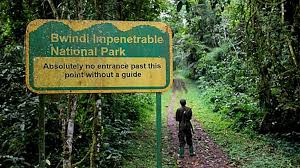
One of the most popular tourist spots is Bwindi Impenetrable National Park, which is situated in the Kanungu district in southwest Uganda, close to the Democratic Republic of the Congo. The national park was established in 1991 primarily to protect the critically endangered mountain gorillas, and in 1994 it was inducted into the UNESCO World Heritage List. Over 468 mountain gorillas, or half of the total population of mountain gorillas worldwide, live in the 321 square kilometer Bwindi Impenetrable National Park. Other locations where mountain gorillas can be found include the Virunga national park in Democratic Republic of the Congo, Volcanoes national park in Rwanda, and Mgahinga gorilla national park in Uganda.
Gorilla trekking.
In Bwindi Impenetrable National Park, gorilla trekking safari is a popular and fascinating sport that lets you explore the dense tropical forests in search of habituated gorilla families and, if you find them, spend an hour with them in their natural habitat. About 23 habituated gorilla families call Bwindi Impenetrable National Park home. These families are distributed among the park’s four sectors, which are Rushaga in the south (home to 8 gorilla families), Buhoma in the north (home to 4 gorilla families), Ruhija in the east (home to 4 gorilla families), and Nkuringo in the south (home to 3 gorilla families).
An exciting safari activity, gorilla trekking in Bwindi Impenetrable National Park begins in the morning with a briefing at the park headquarters. After the briefing, you will be divided into eight groups to trek with each habituated gorilla family. Individuals are grouped based on age, level of physical fitness, and personal preferences. After the distribution of gorilla families, you will begin your jungle trip accompanied by a park ranger who possesses extensive knowledge about both the gorillas and the forest’s routes.
It takes between 30 to 60 minutes to trek with the mountain gorillas, and during that time you can see a variety of animals, plants, and bird species. After the gorillas are located, you will have the opportunity to spend an hour in their natural habitat where you can take pictures, make videos, learn about their habits, lifestyle, and behaviours, watch them eat, and engage in daily activities, among other experiences that will leave you with lifelong memories.
Gorilla habituation experience.
The process of training mountain gorillas in the wild to become accustomed to human presence is known as gorilla habituation. The only place in Africa that provides gorilla habituation experiences is Bwindi Impenetrable National Park, and even then, the activity is limited to the park’s southern Rushaga Sector. It takes a team of researchers, conservationists, guides, park rangers, trackers, and gorilla medics two to three years to finish the habituation procedure.
A group of four individuals is permitted to participate in the full-day gorilla habituation experience, which allows guests to spend four hours with the mountain gorillas while they are becoming used to their surroundings. You will be able to keep an eye on their whereabouts, discover more about their routines and behaviours, help name the gorillas, snap pictures, and document the events throughout the four hours. You spend more time with the mountain gorillas during a gorilla habituation experience than you do during a gorilla trekking session, which makes for extraordinary and thrilling experiences.
Batwa cultural experience.
One fascinating safari activity you shouldn’t skip while on safari in the Bwindi Impenetrable National Park is the Batwa Cultural Experience. You can interact with the Batwa, or pygmies, who used to dwell in the Bwindi forest before it was gazetted into a national park by participating in the Batwa culture experience, which is conducted outside of the park. As part of the Batwa cultural experience, you will walk through the forest with pygmy guides who will teach you about their way of life, including how they hunted small game, built huts out of grass, and used various plant species for medicinal purposes. They will also teach you about gathering and bow-and-arrow hunting. You will also go to their homesteads from the forest, where you may sample their regional cuisine, take in their folk tunes, and hear about their way of life. You will have the chance to learn about the customs and way of life of other people through the Batwa cultural experience.
Bird watching.
One of the best locations to go birding in Uganda is Bwindi Impenetrable National Park, which was named the top birding spot in Africa in 2011. Over 350 different bird species may be found in the Bwindi Impenetrable National Park, including migratory and forest birds, 23 species that are unique to the Albertine Rift, and 14 species that are unique to Uganda. In the park, hiking pathways like as the Buhoma waterfall trail, the Mubwindi swamp trail in Ruhija, and the Bamboo zone are popular spots to observe birds. As a result, during your park birding safari, you should keep an eye out for a number of bird species: giant kingfisher, African green pigeon, crowned hornbill, cinnamon-chested bee-eater, handsome francolin, Rwenzori batis, strange weaver, red-throated alethe, collared apalis, dusky twin spot, tit hylia, bar-tailed trogon, and dwarf honey guide, among others.
Mountain biking/Cycling.
In the Bwindi Impenetrable National Park and its environs, mountain riding is an exhilarating pastime. The programme is provided by Ride 4 a Woman, a local organization for women in the Buhoma sector. Those who wish to engage in mountain biking can hire bikes and begin riding with a knowledgeable guide who is familiar with the park’s paths and many wildlife species, including animals, birds, and primates. Cycling begins in the morning on well-maintained paths, such as the 13-kilometer path that runs from the park’s headquarters to the Ivi River. It takes three to five hours to complete the mountain bike activity in the park. While bicycling, you’ll see a variety of wildlife, including duikers, birds, monkeys, chimps, and breathtaking landscapes in addition to local villages. Those that engage in bicycle activities will be helping the women and the local communities.
Best time to visit Bwindi impenetrable national park.
You may visit Bwindi Impenetrable National Park at any time of year, although June to September and December to February are the finest times to go during the dry season. Because there is less rainfall in the forest during the dry season, the gorilla trekking paths and national park entry roads will remain dry and accessible.
Because there is an abundance of food for the bird species during these months, bird lovers can view a variety of bird species and migratory birds in November to April. Bwindi Impenetrable National Park is also open for visits during the rainy season, from March to May and from October to November. In comparison to the dry season, gorilla trekking permits are easier to obtain during the rainy season because less people are visiting the area. This means that last-minute tourists can still secure gorilla trekking permits, and the park will be less crowded.